WHEN STREET PLAYS SELL SOAP
Daily
Pioneer, New Delhi, July 17, 1997
As
corporate sector and multinationals play up on the roads, Shamsul Islam hits out at
the ultimate degradation of people’s theatre
The street
theatre movement is almost three decades old now. The first of the street
theatre troupes came into being around 1967 in Bihar,
Andhra Pradesh and Delhi.
It is really remarkable that quite a few of these troupes are still alive and
active.
The period
around 1967 is very significant in the history of the Indian polity. This was
the phase in which political, economic, social and cultural institutions were
not only declining but also degenerating. In the world of art and literature
new forms appeared which questioned the rot.
Realism and change became the
mantra for the young and creative writers and art practitioners. It was not
only in the field of theatre but also in the realms of prose and poetry that
new movements like Nai Kahani and Nai Kavita arose which not only decried the
degeneration but also gave visions of hope.
Like wise,
street theatre as a genre was a reaction to the established theatre which only
symbolized the degeneration, strongly resisting any sign of change. This new
theatre campaign emerged as a platform for the anti-establishment forces
providing them the opportunity not only to experiment in new forms but also to
express their dissent against the prevailing reality. Thus street theatre was
not only to be an alternative theatre conceptually, but also had a political
message; to change the world around. It pleaded for an alternative social set-up;
the establishment of a more humane egalitarian society.
It was but
natural that the then theatre establishment reacted quite violently to this new
experiment. It was decried as “gutter theatre”, “sheer slogan-mongering”, etc. The
founder of the National School of Drama, NC Jain, while commenting on the
advent of street theatre lamented the fact that “It is really unfortunate that
the number of such theatre practitioners is growing day by day who believe that
street theatre is the best form of theatre for present and future…”
“For this tribe,
painstaking rehearsals in order to realize the minute details of acting and
presentation or insistence on long rehearsals or to underline the importance of
these tasks are nothing but the bourgeois dictum, art for art’s sake…”
“There are
people in the street theatre movement who regard it as the greatest form of
theatre and are also trying to develop its own aesthetics. In totality street
theatre means a principled hatred towards any kind of disciplined rehearsals or
labour today.”
In spite of
these derogatory epithets, street theatre blossomed into a strong and forceful
theatre movement. It was able to reach large sections of people and inspire
them. The establishment adopted a two pronged strategy to combat the growing
influence of this theatre medium.
One was physical
assault on the street theatre performance. In many states like Kerala, Bihar, Punjab and Andhra Pradesh street
theatre was banned; performers like Prabir Dutta, Rajan and Safdar killed while
performing.
In a gory
incident to the mid 80s at Basti in Uttar Pradesh, a female street theatre
activist was picked up by the police from the midst of a performance and raped
in order to teach her a lesson. In most of the cases, state repression was let
loose in the name of combating Naxalism.
Interestingly,
simultaneous with the repression, concerted efforts were made to co-opt the
street theatre movement by the pro-establishment theatre world. They came
forward to offer their services to teach the street theatre activists the art
of theatre so that the performers could be saved from slogan-mongering in their
performances.
It was an
attempt to turn street theatre into a harmless non-political medium which would
serve the cause of art only. Surprisingly, it was not repression which caused
maximum damage to the street the atre movement but this process of co-option
which resulted in a change of its conceptualisation among a large number of
street theatre practitioners.
Incidentally,
most of these street theatre activists were city-based who were lured into
believing that it was impossible to sustain their genre of theatre in the face
of the all-powerful electronic media. Moreover, the art which they had learnt
from the gurus and messiahs of theatre establishment led them to a path where
simple innovative and improvised street theatre productions easily identifiable
to the common people became highly artistic and elitist costing a lot of money.
Now the street
theatre performances which were becoming extensions of television presentation
or films needed financial resources beyond the capacity of its admiring
audiences on the streets who happened to be commoners and main donors. Highly
artistic productions proved to be hugely expensive and required sponsors.
This new
scenario presented a great dilemma before street theatre. It required funds
from the establishment for anti-establishment cultural work. Now street theatre
looked towards state funding. It is this remorselessness which makes Shabnam Hashmi
of Sahmat argue, “It is taxpayers’ money, we see nothing wrong in accepting
it.”
Unfortunately
Shabnam misses the essential point that donors have a strong tendency of
enforcing their own conditions and agenda. If we make a study of street theatre
groups active during last one decade in the country, it would be startling to
know that most of such groups which had started with some kind of idealism and
pro-people agenda have been converted into nukkad natak teams of the
departments of adult literacy, health, family planning, etc, thus functioning
as an extension of DAVP without even being employed by the Government of India.
Now the corporate
sector and multinationals have entered the scene by funding street theatre
groups (Lehar Pepsi marketing division is working on establishing a foundation
for street theatre) which will propagate to sell their products and ideas to
those large sections of the Indian population which are still not accessible
through the electronic media. The marketing experts of the multinational
consumer giants are of the opinion that in traditional societies like India, street
theatre which is in folk tradition has immense appeal which can be utilised for
broadening the market.
However, there
are street theatre puritans like Neelima of Nishant Natya Manch who, while
admitting that funding of street theatre by Government and corporate sector is
a set back to the lofty ideals of the genre, still believes that all these attempts
are bound to come to naught, as people come to join street theatre performances
because these performances share their sorrows and pains which normally never
get a chance to be aired on the electronic media.
She firmly
believes that street theatre hawking for multinationals is not going to
succeed, “In street theatre you cannot bluff. It cannot be used for selling
noodles, creams or jeans. Street theatre is popular because it identifies with
common people’s aspirations and their dreams. This affinity draws the audiences
to face the sun, dust and all other personal hazards while witnessing the
performances.”
“Why should they
stay to listen to sermons about a commercial product? Such street theatre,
hawking for business people, is aware of this draw back–that’s why it is
resorting to gimmicks like nudity, and vulgar language. It is bound to get
alienated.”
[This
article appeared in Pioneer, New
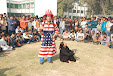
Delhi dated 17-07-1997 and also carried two photographs of Nishant’s
performances outside Jama Masjid, Delhi and in front of AIIMS, New Delhi which
are not reproduced here.]