THE
PIONEER, NEW Delhi, SEPTEMBER 16, 1993
A Believer in the Art of Comedy
In an interview with Bansi Kaul, dramatist from Bhopal, Shamsul Islam
discovers that he has been trying to establish a repertory of clowns.
Bansi Kaul, born amidst the abundant beauty of Srinagar
Valley, originally wanted to become a painter. “There was no dearth of inspiration
for a painter in the life around, so painting was the natural choice.” However,
with his joining the National School of Drama in early 70’s he was groomed to
be a dramatist under the keen guidance of Ebrahim Alkazi. He excelled in the
field of direction, music, though designing remained his first love.
Today, Bansi is one of the most travelled dramatists of the
country. He has not based himself in centres like Delhi. He is always on the move, working with
smaller theatre groups in far flung areas of the country. He is a firm believer
and practitioner of the rich folk theatre tradition of the country. In the
sphere of folk theatre Bansi has done great experiments and has few parallels.
After a long gap he was back in Delhi directing Bargad (Scripted by Tripurari Sharma)
for Sri Ram Centre Theatre Repertory. The play is based on a few sad but real
incidents and took concrete shape in a playwrights workshop funded by Ford
Foundation. Kaul described Bargad as
a very fine play. “This play underlines the truth, that, though life is cruel,
it is naked but life is also beautiful. The poverty is bad looking but the poor
are not ugly. They are yet beautiful. It has immense humanism.” He turned it
into a musical play and described the production as a kind of “musical
realism”.
Bansi does not regret his long absences from the Delhi theatre scene. He
believes he is doing more fruitful work with smaller groups in small towns of
the country. He does not subscribe to the demarcation line between professional
and non-professional theatre groups. “Whoever does theatre wants to do it in a
fine professional manner. It would be very unscientific to divide them as
professional and non-professional. They can at best be divided as full-timers
and part-timers. He is mainly involved with the part-timers because he believes
that these are the people in thousands who keep flying high the flag of
socially purposeful theatre throughout the country.
He cites the examples of theatre groups led by Vijay Mehta,
Prasanna, M.K. Raina and many others, all eveningers, who did pioneer work for
the Indian theatre. “Theatre can not be kept alive only by whole timers or
theatre repertories. Till such part-timers in thousands are available all over
can theatre flourish”
For the last five years Bansi has been single mindedly
working for the establishment of a resource center for comedy theatre. He has
been striving hard to start a “Repertory of Clowns”. He feels, “Unfortunately
in our country no work has been done in the field of comedy theatre. The
laughter which is a basic instinct of human life is non-existent or suppressed.
I firmly believe that only that society can face the worst crisis of life and
death and survive which does not lose sight of humour, satire and inherent
liveliness. Due to repressive feudal environment all around, humour/satire was
always forbidden. In the name of comedy what was practiced was vulgarization,
which suited the rulers well.”
Kaul divides the humour into two categories of physical and
mental. He laments, “Where other Afro-Asian countries have strong traditions of
mental humour, we have none. From China to Turkey we find a character, Mulla
Nasruddin. He is a commoner, a simpleton who not only exposes the feudal
de-humanization and religious fundamentalism of the ruling classes but also
pricks the backwardness, hypocrisy and degeneration of common people. The
stories of Mulla Nasruddin, not only greatly entertain but also have morals in
them.”
Bansi somehow, feels that performances of such satirical
humour will cure lots of ills in society. Bansi admits the fact that in Naqqal.
Amli, Bhaand and Narrative singing, India has a strong tradition of
comedy; however, these were not developed and fell prey to feudal obscenity.
His repertory of clowns, “will not be a collection of circus clowns, it will be
there to enrich the mental humour in the tradition of Mulla Nasruddin”
Bansi has done tremendous work in producing ancient Sanskrit
plays in different Indian languages. “I resort to Sanskrit classics because
these plays are a powerful indictment against religious hypocrisy,
totalitarianism and social injustice. Today Sanskrit language may be a tool in
the hands of Brahminism but in history Sanskrit literature always had a great
legacy of challenging whatever was unjust. It made fun of kings, even gods.
Kalidas is a great pro-woman playwright, and had the guts even to deny the
occurrence of Mahabharata in his play Panchratram.”
He feels sorry for those who treat Sanskrit as part of some religious heritage,
since it suits fundamentalism. While referring to great revolutionary content
of ancient Sanskrit-drama and literature he reminds one that Brecht borrowed
immensely from ancient Sanskrit classics.
Bansi’s definition of good theatre is, “It should entertain,
it should not confine itself to smaller issues. It must have the capacity to
confront human agonies. Do not try to get from theatre what you want to achieve
from a poster. Theater is not slogan mongering. It must analyse society. It
should leave visual impact.”
Bansi has very strong opinions about the role of the state in
the sphere of art and culture. “They are talking of cultural policy, you can
only laugh at them. They do not understand the difference between culture and
art. You can not create and tailor culture. It is not manufactured, it develops
in hundreds of years. Does the government want to say that they will direct and
control this ongoing process? Perhaps what they mean is art!”
In the field of art, too, he is totally against state
intervention. It should be left to artists only. “The world of arts should be
out of bound for politicians and bureaucrats, then only real art activities can
survive.”
The ongoing Kashmir tragedy
has directly affected Bansi. Almost all his family members, relations and
artist friends had to migrate from Kashmir
valley. It has caused him immense anguish and lots of hardships. However, for
him Kashmir problem is not a Hindu-Muslim issue.
“It suits both the ruling classes of India and Kashmir
to explain away Kashmir problem as
Hindu-Muslim problem. Instead of solving the problems of unemployment, poverty
and under development faced by the Kashmiri people they have been made to fight
among themselves as Kashmiri Muslim and Kashmiri Pandits. It is the politics of
postponement which has taken Kashmir to such
an impasse.”
Bansi is regretful of the fact that theatre in Hindi is too
dependent on state patronage. “Art seems to be no priority in the Hindi
heartland. It is essentially part of a manipulation. You don’t perform for
audiences but for getting awards. It has created a vicious circle. The
situation in other languages is entirely different.”
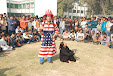
[The print version carried two photographs; one of Bansi Kaul
and other of a performance of Lomad Khan ka Vesh directed by Bansi.]