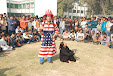
Shamsul Islam, popularly known as
Islambhai, is a renowned Street Theatre personality. He is one of the founders
of Nishant Natya Manch a street theatre group, which was established way back
in 1971. Nishant is known for its quick improvisations and innovations. By now
they have performed over half a century street plays. Some of these plays have
had over 3000 performances in various parts of the county.
Editor's note published in Health
for Millions, Delhi,
July-August 1995
Street Theatre: Changing the Unjust World
Shamsul Islam
Let me admit at the outset that
for a very long period in seventies we relished the misconception that street
theatre (ST) was basically a theatre which would take up issues which belong to
the realm of politics only. This confession of mine, however, should not lead
anyone to believe that I am trying to alter or shift the thrust of ST as a
political movement. ST has always aimed at mobilizing the opinion of common
people as a pre-requisite for change. ST is called, agit prop theatre for the
very basic reason that it wants its audiences and viewers not to remain silent
spectators or neutral to the unjust and repressive life around, but act in a
manner that life is made humane and just. This calls for active participation
in the struggle for correction, demanding a bit of sacrifice also. That is why
ST is a political phenomenon.
The issue I am trying to
underline relates to the content format of the ST.
Should ST confine itself only to raising issues which concern political aspects
like role of politicians, bureaucracy, police or exploitation—foreign as well
as domestic? Though issues like gender bias or religious fundamentalism were
taken up violating the Lakshman Rekha of the prevalent understanding of the
content of ST movement, however, issues concerning environment, health, hygiene
and many others like these were dismissed as of no concern. These later issues
were looked down upon as something reformist in nature and of no concern to ST
activists which were out on roads seeking to change the world.
It was no snobbery on the part of
ST activists that they believed like this. It was their genuine belief that
economic-political issues form the base and all other issues belonged to super-structure.
We should strive to change the base and super-structure will automatically
change accordingly. Moreover, ST performances were addressed mainly to the ruling
classes and exposed their misdeeds and as a principle did not probe into the
weaknesses of the masses. This was the dominant thinking in seventies when ST
originated. ST was too nascent and yet to identify with general masses and
issues concerning them. The ST activists could not have thought otherwise in
the given political situation which prevailed at the end of sixties and the beginning
of seventies. It was the failure of democratic-welfare state of India
which gave birth to the ST movement. It was quite natural that the ST movement
had to be exclusively confronting the same de-generation.
It is an undeniable fact that by
mid-sixties the Indian polity had lost much of its legitimacy. The limited
positive ideas, convictions and organizations we inherited were on the verge of
collapse and had lost their relevance. The immense proportions attained by
price rise, un-employment, black-marketing communalism, Casteism and oppression
of women finally took its toll when monolithic rule of Congress Party was
broken and it got split. In these circumstances when established political
institutions and even press became silent spectators and ditched the Indian
people and betrayed their aspirations, ST came as a genre espousing the cause
of the Indian people and to uphold their honour. This was how ST took up the
issues of political corruption, mismanagement, repression and dictatorial
tendencies among the rulers, initially.
However, the scenario changed
gradually. The ST activists realized very soon that the political issues were
not the only ones which had to be taken up for building a just Indian society;
but also some of the issues which were treated as on the periphery or as fringe
issues. It was through their practical experiences that the ST teams were to
realize soon that at the micro level the unjust system remained entrenched. More
so because within society there were other issues of crisis than just political,
and society could not re-generate unless those issues were also dissected.
Members of Nishant will always
remain grateful to the simple but full of warmth, tribal friends of Hazaribagh
(Bihar) for making us realize that ST performances have to go beyond political
issues if ST is committed to reflect the sorrows and aspirations of common
people of India.
Our face to face interaction with tribals at Hazaribagh made us realize that
new grounds have to be searched and traversed.
I would like to narrate the
actual incident which took place in early eighties (1980s). It all began in the
tribal belt of Barhi Tehsil of Hazaribagh district. We had highly successful
performances which continued beyond midnight,
of our political plays for three days in a row. On the fourth day when we were
relatively in a bigger village and had finished the performances, a group of
tribal women stood up and said that our plays caricaturing and lampooning the
politicians, bureaucrats, Sahookars (money-lenders) and Policewallas were great
and they had enjoyed the same. However, they were frank enough to tell us that
our plays did not take up the issues which were far more serious for them in
and around their village. They explained that their drunkard husbands and the
absence of any medical facility were two things about which they were worried
most. They asked point blank,” do you have plays on these?” We had none. We had
always believed that it was none of our tasks. It was sheer reformism. But
ground reality in that tribal village convinced us that we were out of touch
with reality. It was a total exposure of poverty of philosophy of our kind of
ST. We accepted our shortcomings and promised to present next day, two plays on
their most burning issues.
We honestly realized our fault
and took up the challenge. The entire next day was spent rehearsing on the two
themes. On drunkard husbands we based our play on a story of well known Oriya
writer, who is also known as Premchand of Oriya literature, Fakir Mohan Senapati.
The story titled as ‘Patent Medicine’ is full of action and ends with thrashing
of drunkard husband with broom by wife thus underlying broom as patent medicine
for the drunkard husbands. The play became so popular on the tour that we had
to perform it more than once at every place. It became a play with which the
tribals identified most. Later on we changed the name of the play to 'Ramban'
on the suggestion of a trible woman when we were performing in Udaipur district of Rajasthan. On the issue
of lack of health services, we were lucky to have a copy of the book ‘Where
There is No Doctor’ with us (this book has always been part of properties of
any touring team of Nishant). We took up few aspects from this book and
improvised them into scenes. This innovation also became very popular.
Since then Nishant made it a
point to have plays on health issues in its repertoire. We developed more plays
on personal hygiene, cleanliness, avoiding of over medication, complete
treatment for TB and exposing multinational drug companies. In fact, these so
called apolitical plays helped us greatly in getting closer and familiar to our
audiences. We soon realized that such plays helped us in gaining confidence of
the down-trodden and later when we performed political plays the audiences were
more receptive. Of course, we did not confine our health plays to the issue of
physical health only but roped in the issues of mental health and even social
health. We took care that our plays on health should never look like DAVP or
Song and Drama Division propaganda. We related all these health issues to the
social system which was based on exploitation of men by men. We underline the
fact that health issues were essentially related to the nature of society we
were living in. Better health would require a just and humane society also. For
us, raising of health issues in the ST performances became part of our cultural
struggle to change this unjust world.
Of course, the credit for opening
this new horizon to us goes to simple tribal women of Hazaribagh. We shall
never be able to repay their debt.
[This article also carried two
photographs of Nishant’s performances at Laxmi Bai College (University of
Delhi) and in Tehri, Garhwal which are not reproduced here.]