The Times of India, New Delhi, 15-03-1992
In the Eye of
the Mullah’s Scorn
Shamsul Islam
And yet, street theatre in
Pakistan stands up valiantly as an important weapon of protest, focusing
attention on secularism, women’s equality and the downtrodden. Shamsul Islam
throws light on the movement, after a recent trip to Lahore.
There is a different kind of war
being fought in Pakistan
today. A war against religious fanaticism that is waged through songs, dance
and diatribe, the hallmark of Pakistan’s
subterranean cultural activity: street theatre which continues to exist despite
the stranglehold of the draconian Dramatic Performance Act, 1876. Although the
Act governs theatre activity in India too, its effect gets magnified in
Pakistan due to the ‘mulla raj” there which ensures that street theatre can
never secure the mandatory approval from the administration. Obviously then,
all street theatre activity in Pakistan
remains an illegitimate, guerilla style activity.
But this does not affect its
vibrancy in any way. As theatre-activist Waseem puts it, “the war against
mullaism has to be fought to its logical end. There is no way out. The issue
involved does not concern only a few democratic rights. The dignity of human
race and people’s creativity are at stake. So the fight must go on.”
Street theatre in Pakistan
originated much later than India
and in far worse conditions. By the beginning of the ‘80’s Pakistan had
consolidated into a real theocratic state. Log reigns of martial law combined
with strong doses of mullaism had totally liquidated any kind of protest from
the organised left or centrist forces.
In such a scenario of terror and
silence street theatre in Pakistan
came up to accept the challenges around 1983. Madiha Gauhar, a noted street
theatre activists points out, “In a situation of subjugation and total
censorship, theatre activity of Pakistan somehow got hold of Badal Sarcar’s
Jaloos. We started performing it without any permission. This was the beginning
of the street theatre movement in our country. Along with Jaloos came the
realization that theatre was not only a medium of entertainment but could also
be used for political mobilisation.
Since then street theatre has not
looked back in Pakistan.
Several active groups in Punjab and Sindh are doing pioneer work. The
Lahore-based Lok-Rehas is one of the most active and technically sound street
theatre groups. Comprising both boys and girls, the group performs only in
Punjabi. Maut Da Vipari (on the Gulf war), Kurlat (on rape), Zanani (on the
status of women), Dharti (on landless peasants) and Guddo (on child marriage)
are some of its popular productions. Their latest play focuses on the pathetic
condition of minorities in Pakistan. The group puts up about 250 shows in a
year. All its performances are extremely colourful with a strong content of
folk music and songs. Lok-Rehas has incurred fundamentalist ire several times
and has often been rescued by the audience itself.
Equally important is another
Lahore-based group, Ajoka Theatre (Today’s Theatre) which performs both in
Punjabi and Urdu. It also wants to branch into proscenium, a field in which Lok-Rehas
already excels. Amongst its noteworthy productions are Badal Sarcar’s Jaloos,
Itt (on the brick kiln workers), Dhee Rani (on the status of daughters) and
Choolah (on dowry deaths). Adaptations of Brecht also feature amongst its lists
of accomplishments. Led by the husband-wife team of Shahid Nadeem and Madiha
Gauhar, both of whom lost their government jobs for their political theatrical
activities, Ajoka performed in India in 1988.
Dastak, based in Karachi, performs only in Urdu. It consists
mainly of Mohaijrs from India and is led by Mansoor Saeed who migrated from
Delhi in the early ’70’s. The group has popularized Indian street plays of the
Jana Natya Manch and Nishant Natya Manch in the industrial areas of
Karachi.
Then there are groups like
Simbara (named after the dancing girl from Mohenjodaro) which performs only in
Sindhi in the province of Sindh, and Naya Theatre which is active in Punjab.
Apart from street theatre, the latter is also involved in political puppetry on
themes that are secular, pro-women and for the downtrodden. Unfortunately, they
are not very regular in their shows.
In its essence, street theatre in
Pakistan is not only a revolt against the prevailing system, the different
groups also have distinct regional, linguistic and cultural aspirations. For
instance Lok- Rehas wields the banner of ‘Punjabiat’ and is dead against Urdu
while Dastak articulates the socio-political outlook of the Mohajirs. Simbara,
on the other hand, sees itself as a reflection of Sindhi nationalism.
A distinct feature of street
theatre in Pakistan
is its over-whelming folk flavour. In its form, music and poetry it is either
Punjabi or Sindhi. In its music it surpasses its Indian counterpart. Dastak in
fact, is the only group which performs our kind of urban street theatre.
Another important aspect is its ingenuous use of puppets and masks to heighten
impact and contrary to the prevalent impression, girls are an active component
of street theatre actively in Pakistan too.
But above all, street theatre in
Pakistan has convincingly proved that though the intelligentsia, the print
media, the electronic media have all surrendered meekly to theocracy, street
theatre has not. It has emerged as a powerful weapon against fundamentalist
fascism. Today the greatest challenge that confronts it, says Waseem is “the
attempt of co-option by state sponsored, non-governmental organisations.” Most
of the theatre activists concede that this is a pitfall against which all such
protest groups must guard themselves.
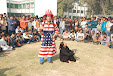
[The Print edition had a photo of
a street theatre performance in Lahore]